カプダドシアはどこにありますか?
トルコのカパドキアはどこにありますか?
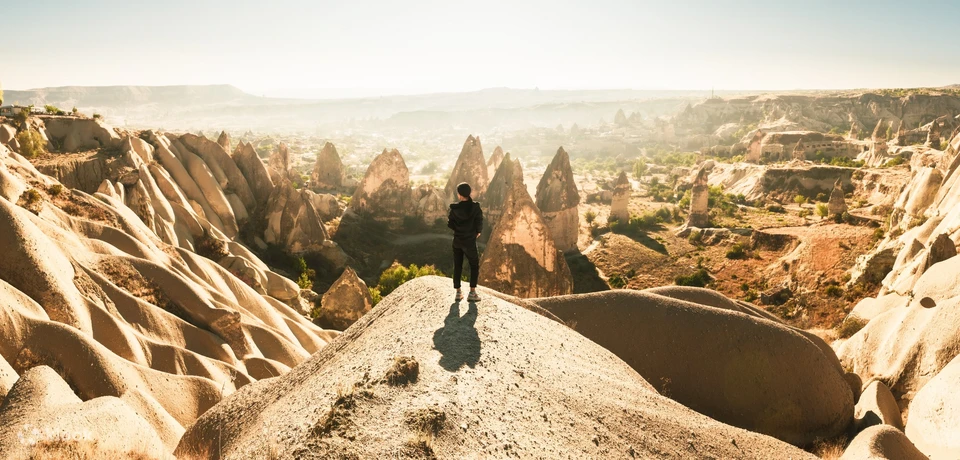
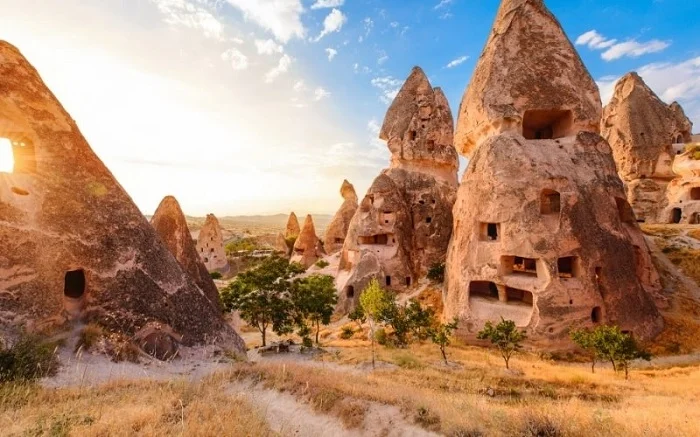
Cappadocia is located in central Turkey, in the province of Anatolia. The area is most well known for the three popular towns of Goreme, Urgup, and Uchisar, but it is the name of a much larger territory that includes the cities of Nevsehir, Kirsehir, Nigde, Aksaray, and Kayseri. So we might claim that Cappadocia is "Five Cities, One Cappadocia"... Cappadocia is known by the Persian name "Kappa Tuchia," which translates as "Land of Beautiful Horses." Cappadocia has breathtaking scenery, natural wonders, fairy chimneys, rock-cut dwellings, gorgeous valleys, stunning lunar hills, and fantastic monuments ranging from the Goreme Open Air Museum to Kaymakli Underground City, Uchisar Castle, Devrent Imagination Valley, Pasabag Monks Valley, and more... The narrow, rocky area of Cappadocia is made up of Uchisar, Urgup, Avanos, Goreme, Derinkuyu, Kaymakli, Ihlara, and other places. Cappadocia is about a three-hour drive from Ankara, Turkey's capital. Cappadocia Airport is close to the town of Gulsehir, and you can fly to it from both Istanbul and Antalya. カパドーシアに関する情報 Cappadocia's secret is concealed in the geological structures that date back 60 million years. The smooth strata produced by the lava and ashes blasted out from Mount Erciyes, Mount Hasan, and Mount Gulludag initially became stony formations, then corroded with rain and wind over millions of years, eventually revealing today's geographic shapes. You may be interested in イスタンブールからカパドキアツアー. Cappadocia has also been home to several civilizations since the Stone Age. Many rock-cut towns, residences, monasteries, cathedrals, chapels, and subterranean cities were erected to take advantage of the region's structure. The majority of the fairy chimneys are positioned inside in this manner. Locals call the easily carved structures in the area "fairy chimneys." They make it possible for people to live in rock-cut caves and underground communities, which have been a true refuge through the ages. You may be interested in イスタンブールからカパドキア2日間ツアー. All of them were built invisibly to hide the people who lived here from the Roman Empire's oppression, persecution, and invasion. Hundreds of thousands of people have lived in them over the years.
カプダドシアの歴史
A cursory glance at Cappadocia's history reveals that the area was busy throughout the Hittite era. The area was a type of commercial hub at the time since it was situated on the famous Silk Road route. It lasted until the Hittites' defeat in the 12th century BC. Following that, the Persians in the sixth century BC, the Kingdom of Cappadocia under Alexander the Great's reign in 332 BC, and the Roman Empire ruled over the area until 17 AD. When Cappadocia's final king died in 17 AD, the territory became a Roman province. Following the arrival of the Christians in the third century AD, the area became a center of education, religion, and thinking. But between 303 and 308, the Roman Empire starts to put more pressure on the people, so they build shelters and towns cut into the rocks in deep valleys that can't be seen from the outside. You may be interested in the 3日間のカプダドシアツアー. During the 11th and 12th centuries, Arab incursions, followed by the Seljuks, controlled the area. During the Ottoman Empire, peace reigned supreme in the area, and after the Treaty of Lausanne, Christians moved to and departed from Cappadocia between 1924 and 1926.
Updated on